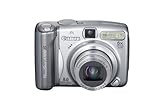
 The PowerShot A720 IS is the quintessential A Series camera in a popular line that matches high-end image quality with fun, easy-to-use features that deliver excellent cost performance. Top-notch specifications include 8.0-megapixel resolution and a long 6x optical zoom with Optical Image Stabilizer Technology for sharp images throughout the zoom range. Canon's DIGIC III Image Processor offers advanced Face Detection Technology and Red-eye Correction for fantastic images. Even expand your creative possibilities with wide-angle and telephoto converter lenses.
Customer Review: Last of the "A" series with manual controls
The Canon "A" series have always been rather unique. They are cameras that are economically priced, yet offer capabilities and features that you usually only see on more expensive cameras. Unfortunately, it looks like the A-720is might be the last of the Canon "A" models with full manual control; the newer A-1000 and A-2000 have only Program AE and Auto (plus some scene modes). The A-720is has three exposure modes that the A-1000 and A-2000 don't offer: Aperture Priority, Shutter Priority, and full Manual, plus the A-720 has Manual Focus control, which has been dropped on the newer "A" series models. Some people might ask, are these manual modes necessary in a compact? I say "yes", because every so often, anyone can get into a photographic situation where you won't be able to "get the shot" with the full-automatic modes. These situations usually involve low-light or poor contrast conditions, for example shooting landscapes at dusk or dawn, or on foggy days. Cameras like the Canon "A" series use "contrast detection" to decide when focus is properly set, and if the scene doesn't have much contrast, the camera's auto-focus will "hunt" excessively and may be unable to find the proper focus at all. When this happens, you can set the camera to manual focus and get the shot, assuming your camera has this capability. As for manual exposure modes, you need Aperture Priority to set specific depth-of-field. For example, in shots where the foreground subject is 4 feet away, and the background is at infinity, you want to use the smallest aperture possible (f8 on most Canon "A" models), so that everything in the frame will be sharply focused. In situations where your subject is in motion, you will often want to control shutter speed - fast for sports and action shots, or perhaps a deliberately slow shutter speed to capture the look of flowing water with motion blur. The Canon A-720is lets you handle any of these situations; the new A-1000 and A-2000 have only some scene modes with no actual manual control. What's good about the A-720is: 1. Very good value at it's price point. I paid $190 for mine. For this price you get an 8 megapixel sensor, 6x zoom lens, optical image stabilization, full manual controls, 2.5" LCD screen (115,000 pixels), and an optical viewfinder. This last is handy for when your batteries are getting low - you can turn off the LCD and still take pictures with the viewfinder. 2. Excellent image quality. Images are sharp, exposure is generally pretty accurate, and color saturation very nice. Of course this isn't a digital SLR, so don't expect miracles, but for a camera small enough to stick in a shirt pocket, the photos are remarkably good. 3. Optical Image Stabilization. Most cameras have this now, so it's not really remarkable. 4. Uses "AA" batteries instead of a lithium pack. This is actually the defining feature of the Canon "A" series - they all are "AA" battery powered. I prefer this as you can get "AA"'s anywhere. Unfortunately, the A-700 series began the current Canon trend of downsizing from four batteries (in the A-600 cameras), to only two. This has caused a noticeable increase in flash recharge time, plus of course the A-720is itself needs battery changes more often than it would if it used four batteries. However, I don't mean to imply that the A-720is is "slow". It's power-up speed, shutter-lag time, and time to first shot are all pretty good, and are at least equal to the average for other cameras of this class and price point. 5. Very simple, yet powerful, control layout and menus. This camera has only a few buttons on it, and the menu is as simple and user friendly as it could be. This camera would not intimidate an older person unfamiliar with modern electronic gadgets. Even with it's paucity of buttons, it still manages to have full manual controls. A really nice feature is the ability to program the direct print button to another function, most useful is probably to change ISO speed. 6. 640 x 480 x 30 frames-per-second video. This is pretty much standard on cameras in this class, so not really a special feature. Like all compact still cameras, the quality of the sound captured during video shooting is horrible - if you want good sound, get a real video camera - but the video image quality is pretty good. Video is stored in the standard MJPEG format. 7. Uses standard, cheap, easy to find SD and SDHC memory cards. You can put an 8 gig SDHC card in this camera for about $20 and it will capture 2888 stills at max image size and best quality, or about 70 minutes of video clips. What's bad about the A-720is: There's not much to dislike here. There are a few features that it doesn't have: 1. No flash mounting shoe, although this is such a small camera that sticking a flash gun on top of it would make it so top-heavy it would be hard to control. 2. No RAW capture capability. This has always been one feature that Canon uses to separates the "A" series from the more expensive "G" series. I guess if you are a serious photographer, shooting subjects that would benefit from using RAW format, you're probably going to use a digital SLR rather than a sub-$200 compact. 3. Occasional exposure and auto-focusing errors. However, this A-720is seems to perform rather better than my old A-620 did, making fewer mistakes. Again, you shouldn't expect DSLR performance from a $200 compact, but that said, I'd guess that at least 95% of all shots that you might take in average lighting conditions, will be error-free. In poor lighting, if the camera can't manage in full Auto pr Program mode, go to manual control and you can probably get a useable shot. 4. Unrealistic ISO speeds. I have never yet seen a $200 digital camera that can get nice looking photos at ISO speeds above 200, maybe 400 in a pinch. The A-720is offers ISO 800 and even ISO 1600. At these settings, the CCD gain has been boosted so much that electronic noise in the image gets really noticeable. The only time I would use these speeds is in a really dark indoor shooting situation where you can't get close enough to the subject for the camera's flash to light it sufficiently. For example at a birthday party where you have only this one opportunity to "get the shot" of your kid blowing out the candles on the cake, using high ISO speeds will get you that once-in-a-lifetime shot, but don't expect to be able to make larger than a 4" x 6" print. High ISO shots from these compact cameras will probably be too "noisy" to make decent 8 x 10 enlargements. If you often need to shoot subjects like this, get a DSLR with a CMOS sensor - some of those cameras can shoot at ISO 1600 with no more noise than at ISO 100. 5. The tripod socket is plastic, and is placed way over on the outside edge of the camera's bottom plate - about the worst placement of a tripod socket I've ever seen, but the camera is so small and light that this shouldn't be too much of a problem in most tripod situations. If you needed to orient the camera on a tripod looking vertically downward, the offset tripod socket could potentially be a real problem. In that case, I'd probably try to secure the side of the camera opposite to the tripod socket to the tripod plate with a large rubber band, rather than clamping down really tight on those plastic threads. A big rubber band would be somewhat inelegant, but better that than risk dropping the camera or stripping the tripod socket threads by tightening down too much. In my opinion, there are two primary reasons to buy a Canon "A" or "SD" series camera: 1) You absolutely have to have a shirt-pocket size camera and nothing larger will do. And you want a camera that has reasonably good image quality at an economy price. 2) You are buying an "expendable" camera that can be used in an waterproof housing for scuba diving or snorkeling. The Canon "WP-DC" underwater housings are economically priced, and you can generally get maybe 100 dives out of one before the o-rings are shot and the housing fails. Any underwater photographer will tell you that NO camera housing is 100% fail-safe. All scuba divers that carry cameras will sooner or later suffer a housing failure, which of course is the end of that camera. The Canon "A" and "SD" cameras with a "WP-DC" housing offer scuba photography up to 130' depth for as little as $350, compared to the thousands of dollars you would risk on a DSLR camera body and lens in an underwater housing. And the image quality from these little cameras is amazing, especially if you use an underwater flash gun like the SeaLife SL-960D. If your photographic needs don't fall into either of the two categories stated above, but you are not quite ready to step up to a full DSLR, I'd suggest you look at one of the newer generation of Ultra-Zoom "performance compact" cameras from Canon, Sony, Panasonic, Nikon, and Olympus. Canon's version is the SX10is. Panasonic's is the DMC-FZ28, a camera that is being very highly rated for performance and value, and that has WAY more capability than any compact like the A-720is, for only about $50 more. CONCLUSION: If you can still find a new one, I'd recommend this camera over an A-2000 or any of the Canon "SD" models (none of the SD's have manual controls, and all of them use proprietary lithium batteries). If you can't find a new A-720is at a reasonable price ($200 or less), and you can live without manual controls, the A-2000is would be my second choice. It's primary image sensor has two-megapixels more resolution than the A-720is (10 vs 8), and a much better LCD screen with double the resolution. The A-2000 has the same 6x lens and is nearly identical in size and weight to the A-720is, and probably has about equal image quality. NOTE: Canon does not currently offer a WP-DC underwater housing for either the A-1000 or A-2000, but they might in the near future. Canon's web page for underwater housings is at: http://www.usa.canon.com/consumer/controller?act=StandardDisplayAct&fcategoryid=113&keycode=underwater_photo I give the A-720is a "highly recommended" rating for quality and value. I just wish Canon was still making it, or that the A-2000is had all of the A-720is's features and controls.
Customer Review: Good Camera. Slow response time.
Excellent camera with good zoom for the price. Only complaint I have is that it takes somewhat longer for it to be ready for a second photo
